
Routine automated security patrols
Quadrupeds solved stairs, grating, and rough ground, then stalled at the manufacturer app. OLO is the software that puts a capable robot on routine security patrols: native support for DEEP Robotics and Unitree models, mixed fleets in one browser, and simulation that can start before hardware arrives.


Why projects stall after a security POC
A modern quadruped robot arrives with impressive movement and a phone app for driving it. What it does not ship with is security patrol software: SLAM for your site, waypoint rounds, camera and sensor capture at the right moments, recordings worth comparing, and an interface the whole security or operations team can run without a robotics specialist on call. That is why so many quadrupeds go quiet once the proof of concept ends.
OLO closes that gap for routine security patrols. DEEP Robotics and Unitree models connect as established integrations, not custom projects, and the same browser workflow maps the site, builds the patrol, streams live feeds, and keeps a complete recording of every round. Expand on your missions with AI vision at waypoints — gauge reading, doors left open, people where nobody should be — plus custom actions and anything the browser forms do not cover. Typed Python or TypeScript SDKs sit underneath for your engineers or ours.
What changes once the dog is on security patrol
Repeatable patrols, comparable results
Automated security rounds follow identical routes and capture from the same positions every time — so missed checks, trespass, and equipment faults show up in the record instead of the next walk-through.
AI eyes on every round
YOLO object detection and multimodal analysis of camera feeds are built into the platform, so the patrol itself does the recognising: a person in a restricted area, a door left open, an obstruction on the route, a gauge read at a waypoint. What the round sees is flagged in its recording, so review starts with the exceptions.
From one engineer's toy to a team tool
Teleoperation, patrol editing, and round review happen in the browser. The quadruped stops living on one laptop and becomes equipment the entire security team can operate.
Multiple dogs, one dashboard
A DEEP Robotics dog on the mezzanine and a Unitree on the ground floor run from the same Portal — separate namespaces, patrol routes, and recordings, no duplicate software stacks.
Rehearse before delivery
Bundled deployments from partners let teams program against a simulated quadruped in the browser while hardware is in transit, using the same tools they will use on the real robot.
How it works
Security patrols on a quadruped use the same five-step workflow as every other robot on OLO. The quadruped-specific work is choosing the model, connecting it, and running mixed fleets.
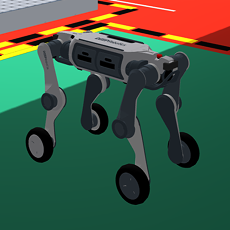
Simulate
Import a 3D model of your environment and run a trial inspection in cloud simulation, from the browser, before anything moves on site.
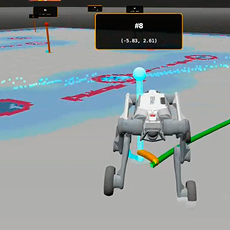
Map
Drive the robot through the real environment once and watch its live map build in the browser.
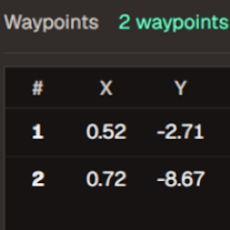
Configure
Place waypoints, define what happens at each stop, and set up the dashboard panels your team will watch.
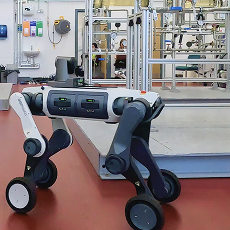
Deploy
Schedule the inspection. The robot follows the route on its own, recording as it goes.
Analyse
Review live feeds during the run, and the complete, timestamped recording afterwards — nothing missed, nothing lost.


Choosing the right quadruped
Most quadruped projects are decided at the order form, months before the robot reaches a site. Whichever manufacturer you choose, these are the checks worth making before you buy:
SDK access
Buy a variant that exposes SDK and ROS 2 interfaces. For Unitree that means the Edu or enterprise trims. Consumer models are driven from a phone app only, and no software can reach interfaces the hardware keeps closed.
Payload and power
Check the dog can carry, power, and connect the sensors your security rounds depend on: cameras, thermal imagers, gas sensors. A patrol is only as useful as the evidence it brings back.
The terrain it will actually walk
Stairs, grating, kerbs, and wet steel separate models more reliably than spec sheets do. Walk the route yourself and take note of the worst surface on it.
Native support
Lite 3, Lynx M20, Go2, and A2-W work with OLO from first use. Other quadrupeds with full ROS 2 support connect too. Anything short of that is a small integration, by your team, or ours.
Frequently asked questions
DEEP Robotics Lite 3 and Lynx M20 and Unitree Go2 and A2-W variants with SDK access are natively supported. Any other quadruped with full ROS 2 support just works; where a model falls short, the gap is a small amount of engineering that we or your own team can close.
Not really — and it isn't an OLO limitation. Unitree provides SDK and ROS 2 interfaces on its Edu and enterprise variants, not the consumer models, and no software can use interfaces the hardware doesn't expose. If you're buying a quadruped for security patrols, specify a model with SDK access — it's the single most common purchasing mistake we see.
Not unless you want to. Mapping, driving, patrol configuration, and round review all happen point-and-click in the browser. Developers can script custom behaviours and AI detection in Python or TypeScript from the same browser when you need them.
Yes. YOLO object detection and multimodal analysis of camera feeds are platform capabilities, not integration projects — point them at whatever the patrol needs to recognise: a person somewhere they shouldn't be, a door left open, an obstruction on the route, or a gauge at a waypoint. Detections are kept with the round's recording, and developers can extend them, or bring external AI models into the same missions, in Python or TypeScript.
Yes. A fleet of dogs, including a mix of manufacturers, runs from one dashboard, with each robot's patrol routes, feeds, and recordings kept cleanly apart.
For the developersof robotics.
Test in simulation. Visualise, teleoperate and script in the browser. No installation required.